Conservation of natural plant biodiversity in situ and ex situ; herbaria and plant living collections
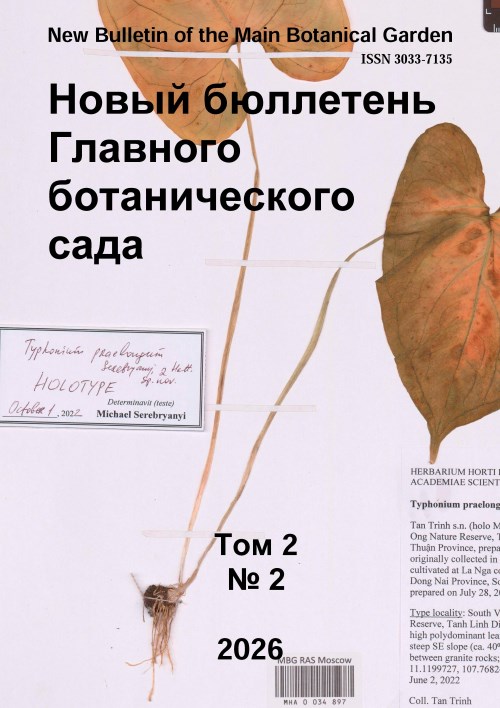
Data on type specimens of the names of taxa of the families Typhaceae, Potamogetonaceae, Najadaceae, Araceae, Eriocaulaceae, Juncaceae, Iridaceae and Orchidaceae, stored in the Herbarium of the Tsitsin Main Botanical Garden (MHA) are presented. There are 64 speciemens of 37 names of taxa of Typha, Potamogeton, Najas, Amorphophallus, Anubias, Cryptocoryne, Eminium, Pseudodracontium, Symplocarpus, Typhonium, Eriocaulon, Juncus, Luzula, Crocus, Iris, Juno, Sisyrinchium, Epipactis, Stelis.
The list of the gymnosperms available in the greenhouse of the Botanical Garden named after S.I. Rostovtsev of the Russian State Agrarian University Moscow Agricultural Academy named after K.A. Timiryazev as of June 2024 is presented. The collection was created to support the botany course in the plant taxonomy section, where the gymnosperms in the first half of the spring semester were studied. It includes 48 species from 24 genera in 9 families of modern gymnosperms: cycads, ginkgos, and conifers. The origin and current condition of the plants are described, special attention to the structural features important for the characteristics of the department is paid. The species included in the IUCN Red List are specially indicated, indicating their current status.
Anatomy, morphology
Invasive goldenrod species Solidago canadensis L. and S. gigantea Aiton are widespread in Central Russia, where they form dense thickets and require comprehensive study for effective control. Despite clear external differences in their overall appearance, there is no precise morphological criteria for species identification based on synflorescence structure. The aim of this work was a comparative analysis of the structural organization of synflorescences of S. canadensis and S. gigantea and the search for stable diagnostic features. It was found that, despite sharing a common structural plan, the species differ in a number of quantitative and qualitative traits. The identified differences complement traditional diagnostic criteria and can be used for reliable species identification.
Landscaping and ornamental gardening
The article discusses the problem of increasing the biological and ecological sustainability of urban green spaces through the proper selection of woody and shrubby plants and the diversity of their plantings. A comprehensive assessment of 78 species, forms and hybrids of woody and shrubby plants growing in outdoor plantings and on the territories of industrial enterprises of the city of Lugansk has been carried out. The surveys were conducted using a route method with an assessment of the ornamental plants during the growing season (by crown shape, leaf structure and coloration, flower and inflorescence size, fruit color, and other characteristics) and an analysis of the dendroflora based on environmental characteristics. It has been established that most of the woody and shrubby plants belong to light-loving species, are characterized by frost and winter hardiness, sufficient gas and drought resistance, low requirements for soil moisture and fertility. Based on the data obtained, criteria for the use of woody and shrubby plants for urban landscaping have been formulated and a scale of requirements for urban plantings has been developed. An assortment of promising native and introduced species is proposed that are resistant to adverse environmental factors and adapted to urban conditions, but have not yet been properly evaluated and widely used in urban green management. A characteristic of the decorativeness of each type is given. The results of the study can be used in planning and implementing greening programs for cities with similar climatic and environmental conditions.
Chronicles and history of botany
The article tells about L.O. Mashinsky, a major specialist in urban green construction, who took an active part in the construction of the Main Botanical Garden of the USSR Academy of Sciences, as well as about his family members who connected their lives with urban landscaping and space biology.