Conservation of natural plant biodiversity in situ and ex situ; herbaria and plant living collections
The Peter the Great Botanical Garden of the V.L. Komarov Botanical Institute of the Russian Academy of Sciences is a center for the introduction of woody, shrubby, and herbaceous plants in Russia. Its grounds preserve old-growth trees of historical and dendrological interest. The park of the Imperial Botanical Garden, established in 1823, is a recognized work of landscape art. Current research priorities include assessing the winter hardiness of introduced woody plants, conducting continuous phenological monitoring of growth and seasonal development, and investigating the biological characteristics and reproductive traits of exotic species. In recent decades, living plant collections have been used to monitor the effects of significant climate warming on both native and introduced plants in northwestern Russia. The study and evaluation of existing collections in botanical gardens, as centers for biodiversity conservation, is becoming increasingly important.
Flora, vegetation, new findings
Taraxacum litorale Raunk. is a distinctive species, well-delineated within the genus by a suite of morphological, ecological, and distributional characters. A typical Baltic taxon, it inhabits maritime and sub-maritime areas in countries bordering the Baltic Sea, ranging from the Netherlands and Norway eastwards to Estonia, Finland, and Russia. In Russia, it was previously reported by Nikolai Tzvelev from the Leningrad Region and by Gunnar Marklund from Pskov Region. We revisited available herbarium material from Leningrad Region, surveyed potential localities in the field, and confirmed its presence there, while records from Pskov Region remain unconfirmed. In Leningrad Region, the species is currently known from three closely situated localities on the Kurgal’skiy Peninsula near the Estonian border. We recommend further searches for this species along other coastal areas of the Gulf of Finland. In gross morphology, T. litorale is readily distinguishable from all other Taraxacum species in Leningrad Region, enabling its reliable identification even by those not specializing in dandelion taxonomy. The sectional position of T. litorale remains uncertain, having been assigned to various groups by different authors. Here, we suggest that its overall morphology and geographical distribution align most closely with sections Naevosa or Hamata. We also consider the prospects for regional-level protection of this species. A distribution map and images of representative herbarium specimens are provided.
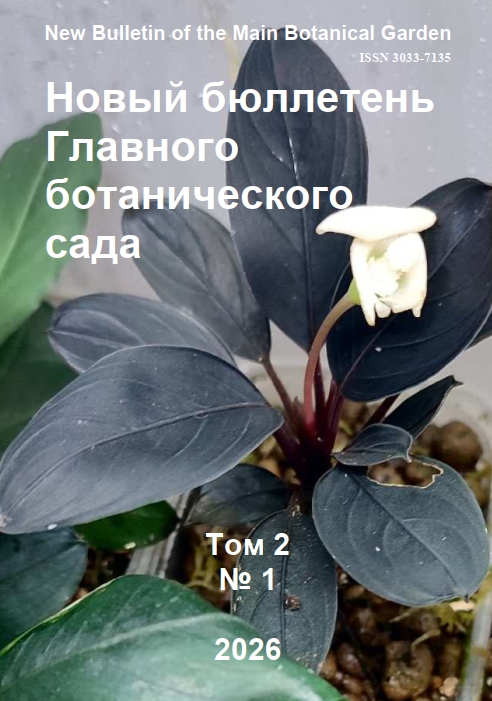
The genus Bucephalandra Schott (Araceae – Schismatoglottideae) is endemic to Borneo and currently comprises thirty-two species accepted. However, the diversity of this genus is estimated to be at least fifty species (Boyce, Croat, 2011 – onwards). This synopsis represents current results of the research on cultivated taxa of the genus available in Russia. It confirms sixteen species of Bucephalandra identified in cultivation based on 59 cultivated clones from 84 specimens. It also enumerates more than 160 cultivated clones identified to the level of a complex/group of species. Some artificial hybrids morphologically differ from plants, growing in the wild. The results are based on the collection of specimens maintained by the author, which represent a fair range of the genus diversity and collections of Russian aquarium hobbyists.
In course of a study of the lichen flora of the Kologrivsky Forest Nature Reserve (northern Kostroma Region, Russian Federation) in 2021, a single specimen of Usnea longissima Ach. was discovered – an epiphytic macrolichen that is very rare in the central part of European Russia. Prior to our collection, U. longissima was found by M.I. Nazarov in 1928 in the spruce-fir forests of the Vetluzhsky district of the Nizhny Novgorod province (within the modern borders of the Kostroma region). Three specimens collected by Nazarov and stored in the lichenological herbarium of the Russian Academy of Sciences (LE-L) are accompanied by information on the abundance and occurrence of the species, a map and coordinates of each of the finds, as well as a black-and-white photograph of U. longissima from 1928 from one of the collection sites.
Chronicles and history of botany
The main milestones of development and current experience of development of the Ryazan City Station of Young Naturalists (RCSYN) in the system of additional education in the natural sciences are characterized. The Station was established in 1959. The Station has evolved from a children station with a practical agricultural focus to a modern, multifunctional institution for supplementary natural science education and upbringing, unique in Ryazan in its objectives and areas, accessible to all schoolchildren. A central focus of his work is a project carried out jointly with the Ryazan State University to study and preserve a large collection of rare and endangered plant species in the region. The Station has effectively become a center for extensive scientific research on the region’s rare and protected plant species. The Station is part of the Russian Children’s Botanical Gardens Network. Introduction tests and scientific research are carried out on 40 species of protected plants. Four ecological exhibition groups have been created: rock garden, psammophyte, forest edge and meadow-marsh areas. Research on the ontogenesis of individual species is carried out in a greenhouse and on the plots In the future, there are plants to expand the collection and develop species programs for different ages and levels of training.