Новый бюллетень Главного ботанического сада

Preview

New Bulletin of the Main Botanical Garden

Advanced search

В издании публикуются оригинальные и обзорные научные статьи в области сохранения естественного биоразнообразия in situ и ex situ, инвазионной биологии растений, флористики, систематики и филогении растений, анатомии, морфологии, физиологии, биохимии и защиты растений, генетики, селекции (в том числе отдаленной гибридизации) и молекулярной биологии, биотехнологии растений, озеленения и декоративного садоводства, методики ботанических исследований.
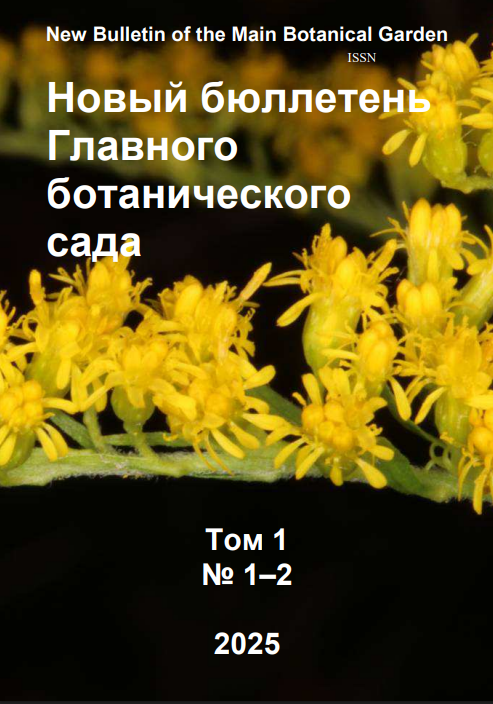
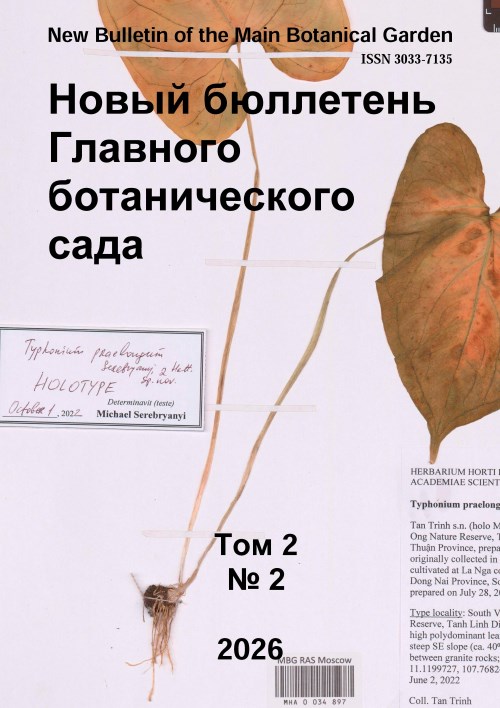
The "New Bulletin of the Main Botanical Garden" is a scientific, peer-reviewed, open-access journal published online. It was registered by the Federal Service for Supervision of Communications, Information Technologies and Mass Media on August 05, 2025 (Registration Certificate El No. FS77-89849 – online edition).  The journal's founder and publisher is the Tsitsin Main Botanical Garden of the Russian Academy of Sciences. It publishes original research and review articles in the following fields: biodiversity conservation (in situ and ex situ), invasive plant biology, floristics, plant systematics and phylogeny, plant anatomy, morphology, physiology, biochemistry and plant protection, plant genetics, breeding (including distant hybridization) and molecular biology, plant biotechnology, landscaping and ornamental horticulture, and botanical research methods. The journal also plans to publish information on botanical conferences and meetings, the history of botany, activities of the Council of Botanical Gardens, as well as anniversaries and memorial dates.

The publication is intended for a wide audience of botanists, staff of botanical gardens, research institutions, nature reserves and national parks, biological stations, as well as researchers, faculty, graduate students, and doctoral candidates.

Current issue
Vol 1, No 3-4 (2025)
View or download the full issue PDF (Russian)

Conservation of natural plant biodiversity in situ and ex situ; herbaria and plant living collections

1-20 43
Abstract

Data on type material of taxa names of the family Cyperaceae stored in the Herbarium of the Tsitsin Main Botanical Garden (MHA) are presented. There are 56 specimens of 33 names of genera Blysmus, Carex, Eleocharis, Eriophorum, Kobresia, Scirpus. Lectotypes of Carex buxbaumii Wahlenb. var. sibirica Litv., C. caryophyllea Latourr. var. pskowiensis Litv., C. chordorrhiza Ehrh. f. exstipitata Litv., C. elongata L. f. pauciflora Meinsh., C. leucochlora Bunge var. subglabra V.N. Vassil., C. physodes M. Bieb. f. elliptica Litv., C. physodes M. Bieb. f. globosa Litv., C. rhizodes Blytt ex Boott var. andrejewi Litv., C. sylvatica Huds. f. angustifolia Litv., Scirpus affinis Roth var. maritimoides Drobow f. megalostachys Litv. have been designated. 

Alien plant invasions

21-32 50
Abstract

Impatiens glandulifera is an alien species listed among the Top-100 invasive species in Russia. We studied five populations of I. glandulifera from several protected natural areas in Moscow: Moskvoretsky and Tushinsky parks, Bitsevsky and Izmaylovsky forest parks, and the valley of the Chermyanka River. Based on the analysis of the intergenic non-coding spacer of the chloroplast DNA (trnV-ndhC), the Moscow samples were divided into three haplotypes, demonstrating a high degree of polymorphism. High polymorphism is characteristic of invasive individuals with an extensive secondary range and high invasive potential. ISSR analysis revealed that the studied samples were most likely introduced to Moscow from three different source populations. However, the origin of the individuals assumed from the ISSR data does not correspond to their chloroplast haplotypes. 

Flora, vegetation, new findings

33-51 54
Abstract

The article discusses nine pollen sequences and their summary diagrams from the Pskov, Smolensk, Tver, and Moscow regions of European Russia, within the mixed (broadleaved-coniferous) forests zone. The sequences are aligned on a unified timescale extending to 5,000 cal yr BP. Selected anthropogenic indicators (AI), including non-arboreal pollen (NAP), Cerealia, Artemisia, and Urtica, were correlated with major primary forest taxa (Picea, Quercus, Ulmus) using this common chronology. A relatively consistent pattern of stepwise agricultural development and human impact within the broadleavedconiferous forest zone is preliminarily established. Within this pattern, five more or less distinct phases of human-induced vegetation and landscape change are identified: 1) The conventional period attributed to the Neolithic–Bronze Age, from approximately 4,500–4,000 (extending to 3,000) cal yr BP, with earlier but doubtful evidences of agriculture (up to 6,000 cal yr BP). During this phase, the AIs reflect a "Forest Neolithic" type of economy, characterized by minimal deforestation and debatable cereal cultivation; 2) The Early Iron Age period, dating to (3,000) 2,800–2,500 cal yr BP; 3) The Migration Period, 1,700– 1,300 cal yr BP; 4) The Early Medieval period including the Viking Age and Old Russian period (1,400– 800 cal yr BP), featuring a pronounced increase in cultivation and rapid changes in forest composition; 5) The Period of New Times (400–100 cal yr BP), during which most diagrams show peak values for anthropogenic indicators, as well as maximum deforestation. 

52-69 43
Abstract

Using ISSR markers and sequences of four plastid DNA regions, the population of Eversmannia subspinosa on Bolshoye Bogdo Mt. in the Astrakhan region was studied. It was found that the population consists of two local subpopulations on the northeastern and southern slopes of the mountain, respectively, each primarily represented by a single vegetative clone. Analysis of molecular genetic data revealed that: 1) both subpopulations are characterized by exceptionally low genetic diversity and extremely low expected heterozygosity; 2) they are strongly genetically differentiated from each other; 3) each possesses its own specific plastid haplotype, distinguished by the pattern of indels distribution. Gene flow between the subpopulations is absent. Within both subpopulations, reproduction occurs almost exclusively vegetatively, with the role of seed regeneration being negligible. It is likely that these characteristics result from the marginal, isolated position of the population at the northwestern boundary of the E. subspinosa range and its growth in conditions unfavorable for this species over the last several tens of thousands of years. 

Критика, библиография, наукометрия

70-80 37
Abstract

The paper presents a comprehensive analysis of the publication activity and citation impact of the researches from N.V. Tsitsin Main Botanical Garden of the Russian Academy of Sciences (MBG RAS) for the period from 2020 to 2024. The study is based on the data from the Web of Science Core Collection (WoS–CC) database and the Russian Science Citation Index (RSCI). The dynamics of the growth in the number of publications, citation metrics, and the most popular journals for manuscript submissions were analyzed. Over the five-year period (2020–2024), 220 journal articles were indexed in WoS–CC and received 1 469 citations. The greatest contribution to the amount of citations came from fundamental review works (checklists of moss species, floristic summaries), which were cited extensively by both Russian and foreign researchers. The analysis of the RSCI demonstrated a high citation rate of the works, especially in the fields of floristics, invasion biology, and nature conservation. The results confirm the high scientific reputation and relevance of the researches of MBG RAS for both the global and the Russian scientific community. 

Anniversaries and dates

81-92 42
Abstract

In 2025, the Tsitsin Main Botanical Garden of the Russian Academy of Sciences celebrates the anniversaries of scientists who have contributed to Russian botany: M.A. Rozanova (experimental taxonomy, selection), A.V. Poptsov (seed biology), A.K. Skvortsov (taxonomy, herbarium), and G.N. Zaitsev (application of mathematical methods in botany). 


Creative Commons License
This work is licensed under a Creative Commons Attribution 4.0 License.